


Файли cookie допомагають нам забезпечити безпеку сайту та покращити ваш досвід користування. Дізнайтеся більше або змініть свої налаштування файлів cookie.
Ми використовуємо файли cookie, щоб забезпечити вам найрелевантніший досвід.
120 mm Precision-Guided Mortar Munition (PGMM)
Категорія

Ammunition, Missiles and precision weapons
Опис
Development In 1975, Diehl was awarded a contract by the former West German Ministry of Defence, to perform a feasibility study into a terminally guided mortar projectile. Bodensee Werk Geratetechnik, AEG and Eltro were also involved in the project. The projectile which resulted from this study was the Diehl Bussard (Buzzard). The objective of the study was to combine the advantages of traditional gun-launched projectiles with those of guided missiles. This would mean the resulting munition could be used from
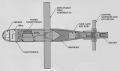
existing ordnance; has a high first-round hit probability, even against moving targets; and would permit engaging armoured targets in the top attack mode. Successful firings of the first development models took place in 1983 with, at one point, three out of three direct hits being attained. By the mid-1980s, the Bussard project had been suspended for funding reasons, only to be revived when the US Army issued a requirement for a 120 mm Precision Guided Mortar Munition (PGMM) for deployment with the M120/121 120 mm Battalion Mortar System (qv). Lockheed Martin joined with Diehl for the selection contest. In October 1994, they were awarded a Phase I critical components demonstration contract to continue development, along with another team formed by British Aerospace , Alliant Techsystems and Rockwell, which proposed an enlarged Merlin 81 mm terminally guided mortar projectile allied with a Hellfire missile warhead. Two other contestants, Saab Missiles and Hercules, were eliminated from the PGMM contest at that stage. In June 1995, it was announced that the Lockheed Martin/Diehl PGMM submission had been selected as the sole entrant for Phase II of the PGMM programme. A US$10.8 million advanced technology demonstration contract was awarded by the US Army Armament Research, Development and Engineering Center (ARDEC) to permit Lockheed Martin/Diehl to manufacture seven prototype rounds, later increased to 10, for live test firing to be held at Yuma Proving Ground, Arizona, from late 1997 onwards. A prototype PGMM round was fired from the Meldorf Proving Grounds in Germany during November 1995 and reached a range of more than 6,500 m. The PGMM can be fired from all existing 120 mm ground-mounted or self-propelled mortars, including the Lockheed Martin 120 mm lightweight composite mortar. No attachments, assembly before use or sustainer propellant sections are required. Description The 120 mm PGMM is based on the Diehl Bussard but considerably revised to meet the PGMM requirements. It is a passive, gliding, intelligent 120 mm mortar munition with a maximum range of 15,000 m. The nose of the projectile contains the seeker section, comprising a low-cost cooled mid-wave infra-red sensor, the associated processor, and gyro units. A mid-body section contains thermal batteries, power conditioning and four switch-blade wings. This section is followed by the warhead, comprising a tandem shaped charge, the fuze and the safe and arm unit. The tandem shaped charge is taken from the German Panzerfaust 3 anti-armour weapon series (produced by Dynamit Nobel) and enables the PGMM to be deployed against targets such as bunkers as well as armoured targets. The tail section contains the control activation system, the four control fins and the fin deployment mechanism. The propulsion system, including the igniter, is at the rear (base) of the projectile body. The PGMM can be operated in two modes. One is the Man-in-the-Loop mode where the projectile is guided by a laser designator operated by a forward observer; the projectile uses its imaging infra-red seeker to detect and track the designated target. For the Fire-and-Forget mode the PGMM operates autonomously, using the same imaging infra-red sensor as before but in conjunction with a target image processor. In this mode the projectile can detect and acquire both moving and stationary targets emitting infra-red radiation. Before deploying the PGMM and following a call for a fire mission, the usual ballistic calculations are made at a fire direction centre and fire orders are given to a 120 mm mortar team. The PGMM is then loaded and fired in the normal manner. The onboard thermal batteries are activated by the launch acceleration and begin to power the system electronics. Immediately after launch the tail fins deploy to provide aerodynamic stability. After the apogee of the trajectory the wings deploy and the projectile commences a relatively straight line target acquisition glide trajectory toward the target area. For a laser-guided mission the seeker searches for a designated target. If laser radiation is detected the autopilot assumes a Man-in-the-Loop operation and begins homing on the signal, following the laser signal to the target. During an autonomous fire mission the infra-red scene is evaluated for potential targets and the PGMM then homes onto the highest ranked infra-red signature. The seeker can search a 500 × 500 m footprint although this could be upgraded to 1,000 × 1,000 m. In both modes, close to the end of the homing phase and as the target resolution improves, a target aimpoint is computed before the hit.