


Cookies help us keep our website safe and give you a better experience. Read more or change your cookie settings.
We use cookies to give you the most relevant experience.
Cartridge, 40 mm: L/70 PFHE


Region

South Africa

Brazil

South Korea

Singapore

Finland

Sweden

Italy

Spain

Belgium

France
Category

Ammunition, Missiles and precision weapons
Description
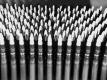
The 40 mm L/70 PFHE is a fixed round with a brass cartridge case. The cartridge case is crimped rigidly to the projectile by two 360º crimping bands. A copper drive band encircles the projectile just above the cartridge case/projectile junction. The 40 mm L/70 PFHE projectile uses a curved base ('duck-tailed') shell body manufactured from a special high-fragmentation steel. The explosive content is 120 g of Octol. The shell interior walls are lined with a total of 650 spherical tungsten carbide pellets, each 3 mm
in diameter. The forward end of the streamlined projectile is occupied by the proximity fuze which operates on the Doppler principle. The fuze has an automatic sensitivity control, to prevent initiation by surface objects and sea or ground reflections when passing over them at the low altitudes produced by low gun-barrel elevation angles. It also has a high-sensitivity electrical impact function and an electrical self-destruct device, together with delayed arming and bore and muzzle safeties. In addition to the above the fuze also features Electronic Counter-CounterMeasure (ECCM) circuits to combat jamming. The fuze arming distance is 200 m and proximity enable range 500 m. TDA of France produces T40 EMMA M and T40 ER M proximity fuzes for use with L/70 Bofors naval guns. In the event of a proximity burst the fuze functioning causes the 120 g Octol main charge to detonate, producing a very high blast effect. The force of the detonation causes the projectile body to shatter into approximately 2,400 fragments. Of these, 650 are tungsten carbide pellets that move outwards at a velocity of between 1,000 and 1,500 m/s. Due to their shape and mass the pellets have a low drag factor and can thus inflict considerable damage on target components several metres from the burst. The curved projectile base also increases fragmentation in the event of a late burst. The projectile self-destructs after 8.5 seconds. When fired against aircraft targets the fuze triggering distance is 6.5 to 7 m. Against missiles, the distance is about 4.5 m. When firing against a target flying at an altitude of approximately 5 m the triggering distance is about 3 m. The brass cartridge case has a semi-rimmed base and is fitted with a percussion primer with a sinoxide detonator.