


Cookies help us keep our website safe and give you a better experience. Read more or change your cookie settings.
We use cookies to give you the most relevant experience.
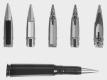
30 × 170 mm Oerlikon ammunition


Region

Argentina

South Korea

Finland

United Kingdom

Greece

France

Switzerland
Category

Ammunition, Missiles and precision weapons
Description
The 30 × 170 mm Oerlikon ammunition is oerlikon Contraves Pyrotec AG 30 × 170 mm KCB rounds are fixed, with the steel projectiles rigidly fixed into the lacquered steel cartridge cases by crimping points which engage in cannelures on the projectile body. A single sintered iron drive band is used on the streamlined projectiles. The same 170.3 mm long necked cartridge cases are used for all types of round in the KCB family and are each filled with 160 g of an NC single-base propellant. A percussion primer is
threaded into the base of the cartridge case. All types of projectile are ballistically matched and have a muzzle velocity of 1,080 m/s. Oerlikon Contraves Pyrotec AG's 30 mm KCB ammunition family includes the following rounds: HE-I The HE-I projectile is a thin-walled steel shell pressed from a steel blank by a technique ensuring high fragmentation. The filling is 40 g of Hexal P30 which, when detonated, has been demonstrated to produce an average of 1,133 fragments (of which only 0.05 g is dust) in addition to the blast and incendiary effects. The projectile nose is largely occupied by an impact nose fuze originally known as the Type F-831-L3, now the KZC-L3. HE-I-T This projectile is much the same as the HE-I but the base of the projectile is occupied by a tracer element so the explosive filling is reduced to 25 g of Hexal P30. After firing, the tracer burns for an average of 4 seconds, during which time the projectile will have reached a range of approximately 2,700 m. SAPHEI The projectile for this round is manufactured from tempered steel and has relatively thick walls. As the nose of the shell is blunt, for armour penetration efficiency it is covered by a light aluminium windshield to maintain the correct aerodynamic outline. The base of the projectile is occupied by a base impact fuze, known as the BZC-L5, which functions after a short delay following an impact to detonate 20 g of Hexal P30 inside the target armour. In this way blast, fragmentation and incendiary effects are added to the target penetration. The fuze provides projectile self-destruct after 6 to 11 seconds. TP This training round is a hollow steel shell containing an inert material. The nose fuze is replaced by an aluminium plug, with an outline corresponding to operational KCB rounds.